

Comfortable, secure and ready for adventures
How to Measure Your Dog
A good fit starts with an accurate measurement—not a guess based on breed or weight. Use a soft tape, keep your dog standing naturally and compare your measurements with the chart shown on the individual product.
Before you begin
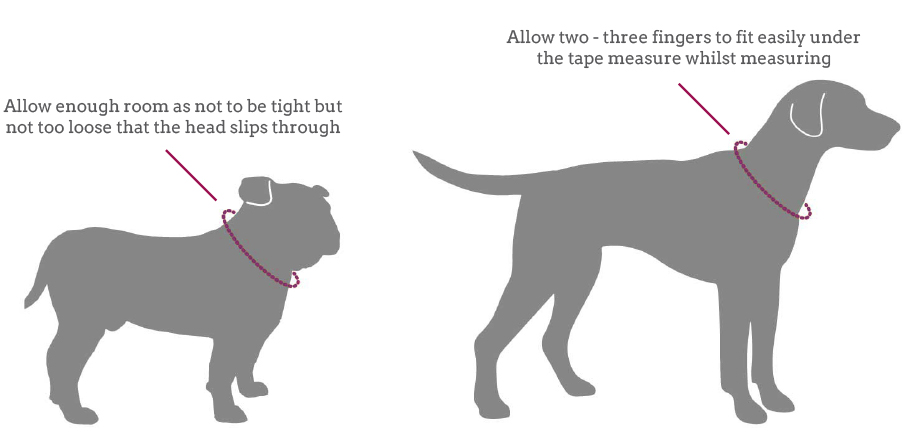
Guide one
Measuring for a collar
Measure around the base of the neck where the collar naturally sits. Allow enough space to slide two fingers comfortably between the tape and your dog.
For an accurate fit
- Measure your dog directly rather than relying on an old collar, which may have stretched.
- Choose a product where the neck measurement sits comfortably within its stated adjustable range.
- For a slip-over or martingale style, also measure the widest part of the head so it can pass safely over the ears.
- After fitting, confirm the collar is comfortable but cannot slip over the head.
Guide two
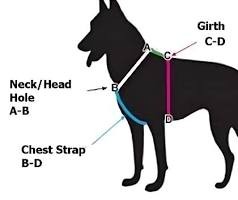
Measuring for a harness
Product designs differ, so always use the measurements requested on that product page. Chest girth is usually the most important.
Three useful measurements
- Chest girth: around the widest part of the ribcage, usually behind the front legs.
- Lower neck: around the base of the neck where harness straps naturally sit.
- Back length: from the base of the neck along the spine to the base of the tail, where requested.
Fit check
- The harness should remain clear of the armpits and should not rub when your dog walks.
- You should normally be able to slide two fingers beneath the straps.
- Check that your dog cannot reverse or twist out of it before going outside.
Guide three
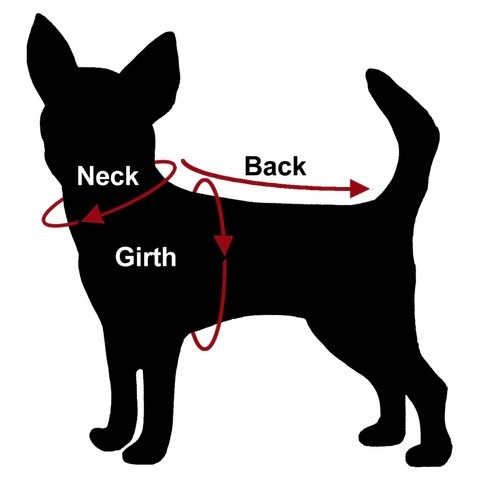
Measuring for a coat or jumper
Measure while your dog is standing straight on a flat surface. Do not measure while they are sitting or curled up.
The key measurements
- Back length: from the base of the neck, where the collar sits, to the base of the tail.
- Chest girth: around the widest part of the ribcage.
- Neck: around the base of the neck without pulling the tape tight.
Allow for layers and movement
Check whether the coat will be worn over a harness and whether it has a harness opening. For thick or double coats, measure close to the body without compressing the fur heavily. Your dog should be able to walk, sit and lie down comfortably.
Frequently asked sizing questions
My dog is between two sizes. Which should I choose?
Use the product-specific measurement range and consider how adjustable the item is. A coat may sometimes benefit from a little extra room, but a collar or harness must still be secure enough not to slip off. If neither range looks right, contact us before ordering.
How do I know whether a harness fits correctly?
It should sit clear of the armpits, allow natural shoulder movement and remain secure when your dog turns or moves backwards. You should normally be able to fit two fingers beneath the straps without leaving enough slack for an escape.
Should I measure my dog while they are sitting?
No. Ask them to stand naturally on all four paws. Sitting changes the shape of the chest, neck and back and can produce misleading measurements.
Can I use my dog’s weight or breed to choose a size?
Use them only as a secondary check. Dogs of the same breed or weight can have very different proportions, so actual neck, chest and back measurements are more reliable.
My dog wears a harness—do I need a special coat?
Look for a harness opening. If the coat has none, the harness may need to sit over it. Check that both items still fit safely together without restricting movement or creating pressure points.
How often should I check the fit?
Check puppies weekly. For adult dogs, check periodically and whenever their weight, health, coat thickness or grooming style changes. Also inspect collars and harnesses for wear before use.
Can I measure an old collar or harness?
Measuring your dog directly is safest. If you must use an existing collar, measure from the buckle to the hole currently used—not the full end-to-end length. Bear in mind that old straps may have stretched.
Still unsure about the right size?
Send us the product link and your dog’s measurements through our contact page. We would rather help before ordering than ask you and your dog to negotiate with a tape measure twice.